Lock Shop Direct measurement guide
How to Measure a Cam Lock
Use this guide to measure a replacement cam lock for a locker, cabinet, drawer, letterbox or other panel-mounted application.
Important: Measure the lock body from the back of the visible head to the end of the body. Do not include the cam or tailpiece in the body-length measurement.
1. Measure the body length and panel thickness
The main measurement is the usable body or barrel length. Remove the lock where possible and measure from the rear face of the visible head or flange to the end of the threaded or clip-retained body.
Also measure the full thickness of the door, drawer or panel. The body must pass through the panel and leave enough room for the nut, clip and cam to operate.
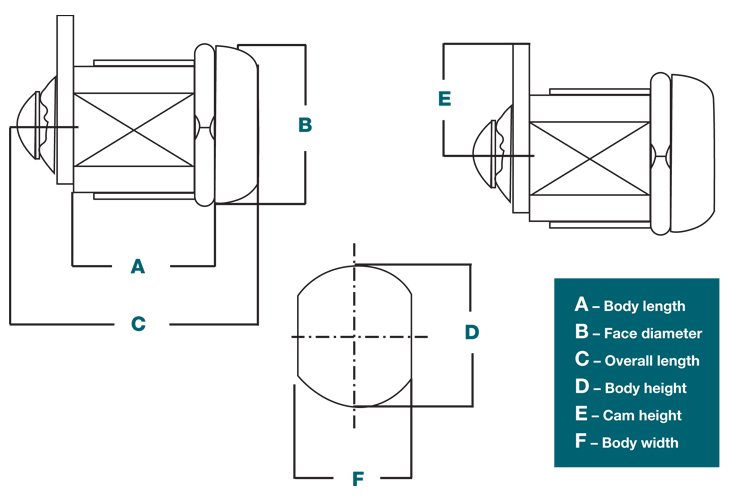
Cam lock body measurement: Measure from the back of the visible head to the end of the lock body. Do not include the cam or tailpiece.
| Measurement |
How to check it |
Your measurement |
| Body length |
Rear of the visible head or flange to the end of the lock body. Do not include the cam. |
_____ mm |
| Panel thickness |
Full thickness of the cabinet, drawer, locker or door panel. |
_____ mm |
| Body diameter or profile |
Measure the diameter and note whether the mounting hole is round, D-shaped or has flats. |
_____ mm / ______ |
Common mistake: Do not measure the total length of the lock including the cam. Body length, panel thickness and cam length are separate measurements.
2. Identify the head, hole and fixing style
Check the shape and size of the visible head. Common styles include round, square, hexagonal, flush and recessed heads.
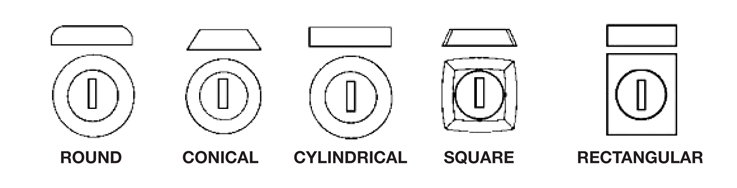
Head shape: Compare the visible face of your existing lock with the available replacement. The head must suit the existing opening and surrounding surface.
Check the mounting hole and any anti-rotation flats. A replacement with the wrong body profile may turn in the panel or may not fit the existing hole.
Record how the lock is secured behind the panel:
- Threaded nut
- Spring clip or horseshoe clip
- Screw fixing
- Another manufacturer-specific fixing
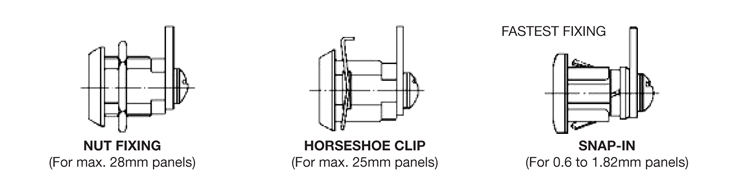
Fixing method: Check whether the lock is retained by a threaded nut, a spring clip or another fixing. The replacement must be compatible with the panel and mounting hole.
3. Measure and identify the cam
The cam, sometimes called the tailpiece, is the metal arm that turns behind the panel to secure or release the door or drawer.
- Measure from the centre of the cam fixing or pivot to the working tip.
- Record whether the cam is straight, cranked, offset, hooked or forked.
- Measure any forward or backward offset.
- Record the cam's starting position and direction of travel.
- Check how the cam is attached to the lock.
Do not assume the existing cam can be reused. The fixing hole, indexing and clearance must be compatible with the replacement lock.
| Cam detail |
Your information |
| Centre of fixing to working tip |
_____ mm |
| Shape |
Straight / cranked / offset / hooked / other |
| Offset |
_____ mm forwards / backwards |
| Starting position and direction |
________________________ |
4. Check rotation and key withdrawal
Record the required movement, such as a quarter turn or half turn, and whether the lock turns clockwise or anticlockwise to lock.
Check whether the key can be removed:
- In the locked position only
- In the unlocked position only
- In both positions
Also note whether the lock is standard rotary, spring return, slam action or compression action.
5. Choose the keying arrangement
Keyed to differ
Each lock is supplied with its own individual key.
Keyed alike
Several compatible locks operate with the same key. Order them together or select the stated key number where this option is available.
Master keyed
Individual keys operate their own locks and an authorised master key operates a defined group. Compatibility is specific to the product range and master-key system.
Still not sure which cam lock you need?
Send our team clear photographs and the following information before ordering:
- Front, side and rear photographs of the complete lock
- Body length, panel thickness and body diameter or hole shape
- Head shape and fixing method
- Cam length, shape, offset and direction of rotation
- Required keying arrangement
Telephone: 0330 174 0851
Email: info@lockshopdirect.co.uk
Browse cam locks
All measurement guides
This guide is intended to help identify and measure replacement hardware. Product designs and terminology vary by manufacturer. Always compare the complete product specification and fitting instructions before ordering.