Lock Shop Direct measurement guide
How to Choose and Measure a Door Closer
Use this guide to identify an existing door closer and record the door, mounting and performance information needed to select a suitable replacement.
Important: Fixing-hole dimensions alone are not enough. Door width, weight, swing, mounting position, site conditions, closing force and fire-door requirements must all be considered.
1. Identify the closer type and mounting arrangement
Door closers are selected by application, door size and mounting arrangement. Identify the existing closer before measuring fixing holes.
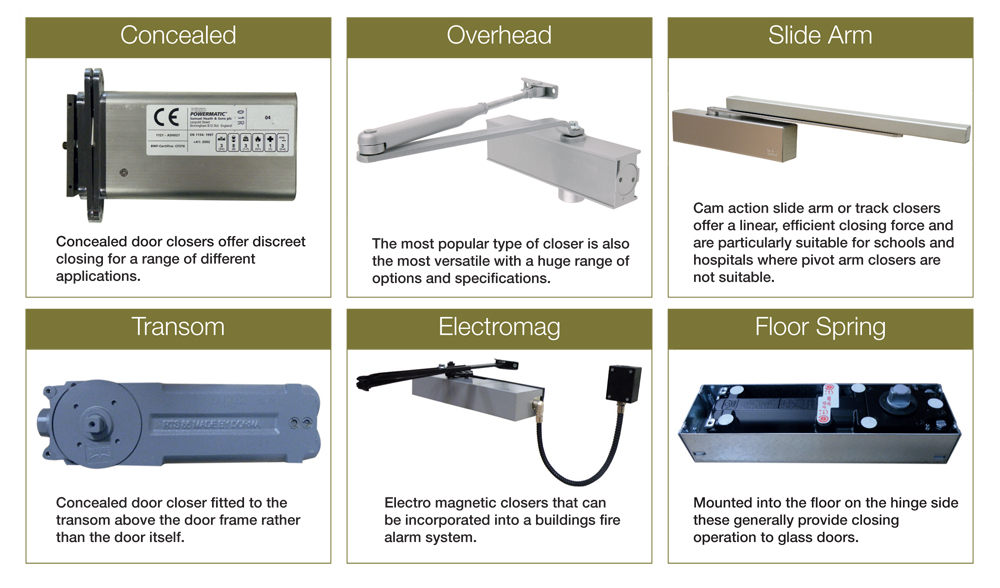
Identify whether the closer is overhead, slide rail, concealed, transom, floor spring, spring closer or electromagnetic hold-open.
Overhead scissor arm
Closer body and projecting link arm mounted to the door or frame.
Overhead slide rail
Closer body works through a compact guide rail. Mounting geometry differs from a scissor arm.
Concealed closer
Body is recessed in the door, frame or head. Door thickness and preparation are critical.
Floor spring or transom
Used for heavier, double-action or glass/aluminium doors. Pivot geometry and door weight matter.
Spring closer
Simple mechanical closer for limited applications. Check fire-door and performance suitability.
Electromagnetic hold-open
Must release correctly on alarm or power failure and be suitable for the complete fire-door arrangement.
2. Record the door and application
The door leaf width, weight and site conditions determine the closing force and product range. Record:
| What to check |
How to measure or identify it |
Record |
| Door leaf width |
Hinge side to closing edge of the active leaf. |
_____ mm |
| Door height |
Top to bottom of the leaf. |
_____ mm |
| Approximate weight |
Use door-set information or manufacturer data where available. |
_____ kg |
| Door material |
Timber, steel, aluminium, glass, composite or another construction. |
________ |
| Swing and handing |
Single action or double action; pull/push side and hinge side. |
________ |
| Exposure |
Internal, external, wind pressure, stack pressure or high traffic. |
________ |
| Fire/smoke door |
Rating, door-set manufacturer and existing closer evidence. |
________ |
3. Check mounting position and available space
- Closer body mounted on door leaf or transom.
- Hinge side or opposite hinge side.
- Standard, top-jamb or parallel-arm mounting.
- Frame reveal, soffit depth and door stop projection.
- Available width for the body, arm shoe or guide rail.
- Opening angle and any wall, reveal or adjacent-door obstruction.
- Existing fixing centres only if seeking a model-for-model replacement.
Different mounting positions can change the effective closing power and opening angle. Use the manufacturer’s template for the exact installation.
4. Choose the required performance and features
Door closer ratings and functions vary. Check the product data for the selected mounting position.
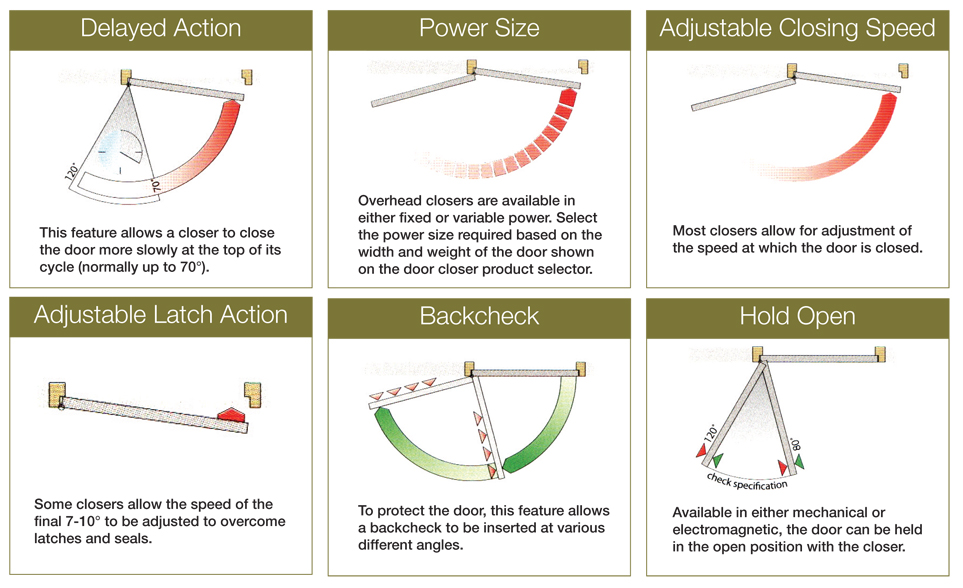
Common adjustable functions include closing speed, latching action, backcheck and delayed action.
Closing force
Select the required EN power size or adjustable range for the leaf width, weight and conditions.
Closing speed
Controls the main sweep of the door. It must not be used to compensate for a binding door.
Latching action
Controls the final part of travel so the door overcomes the latch and seals.
Backcheck
Hydraulically cushions forceful opening. It is not a substitute for a door stop.
Delayed action
Allows slower initial closing where suitable for the building and door.
Hold-open
Mechanical or electromagnetic. Fire-door use requires the correct approved arrangement.
5. Fire doors, accessibility and double doors
Fire and smoke doors: The closer and mounting arrangement must be suitable for the particular door set. The door should close fully into the frame from any opening angle and overcome the latch, seals and air pressure.
- Do not fit an unapproved mechanical hold-open device to a fire door.
- For double fire doors, check whether a closing-sequence coordinator is required.
- Consider opening force and accessibility as well as reliable closing.
- Correct misalignment, hinge problems, floor drag and damaged seals before increasing closer power.
- Use a competent installer where the door is fire rated, very heavy, double action or part of an access-control system.
Still not sure which product you need?
Send our team clear photographs and your measurements before ordering. Please include:
- Photographs of the complete door from both sides and the existing closer label.
- Door width, height, material and approximate weight.
- Hinge side, opening direction and closer mounting position.
- Frame reveal, soffit and available mounting space.
- Fire/smoke rating and required functions such as backcheck or delayed action.
This guide is intended to help identify and measure replacement hardware. Product designs, terminology and handing conventions can vary by manufacturer. Always compare the complete product specification and fitting instructions. Where a door or fitting forms part of a fire escape, fire door, powered system or other safety-critical installation, obtain advice from a competent person before ordering or altering the hardware.